How to track internal training in your company

In this article
- Why tracking is a key part of internal training
- What problems appear when there is no tracking
- What to measure when you track internal training
- Useful indicators for internal training tracking
- Individual tracking and group tracking
- How to detect signs of low activity
- Completion criteria: when to consider training completed
- Evidence and traceability of completed training
- How to use data to improve training
- What an e-learning platform should make easier
- From controlling training to supporting people better
Organizing internal training is important, but once it is underway, an equally relevant question appears: how can you know whether it is really working? When companies track internal training, they gain visibility into who accesses the course, who progresses, who completes the activities, what results are achieved and which people may need support.
If your company is still at an earlier stage and needs to structure its courses, materials and processes more clearly, it may be useful to start by reviewing how to organise internal training before going deeper into tracking.
When internal training is managed with scattered tools, tracking often depends on emails, spreadsheets, manual confirmations, external forms or information distributed across different people. This may work for occasional training actions, but it becomes difficult to sustain when the company needs to train people regularly, work with different profiles, justify completed training or make data-based decisions.
Tracking internal training is not just about control. It is about having visibility to support people better, detect difficulties early and improve the impact of training.
Why tracking is a key part of internal training
A training action does not end when content is published or a session is delivered. For training to have real value, the company needs to know what happens afterwards. Tracking makes it possible to check whether people access the materials, progress through the planned learning path, complete the activities, meet the defined criteria and generate useful information for improvement.
Without tracking, a company may be investing time and resources in training without having a clear view of its results. This is especially relevant in recurring training processes such as onboarding, internal procedures, product training, risk prevention, compliance, customer service, digital tools or sales training.
In all these cases, it is not enough to simply “make training available”. The company needs to know whether people are completing it and whether it is fulfilling its purpose.
What problems appear when there is no tracking
Without clear internal training tracking, several problems can appear:
- Lack of visibility. The company may know that a training action has been launched, but not who has started it, who has completed it or who has stopped halfway.
- Late intervention. If difficulties are not detected during the process, someone may stop progressing without anyone noticing until the end, when it is harder to correct the situation.
- Administrative workload. When tracking is done manually, every report requires collecting data from different places, checking spreadsheets, comparing answers or asking several people for confirmation.
- Lack of evidence. In some training processes, especially when they are mandatory, assessed or subsidized, the company needs to keep information about participation, activity, results or completion.
- Difficulty improving. Without data about activity and results, it is harder to know which content works, which activities raise questions, which profiles need support or which training actions should be updated.
What to measure when you track internal training
To track training properly, it is not necessary to measure everything. The key is to identify which information is useful for the company and for the people responsible for training.
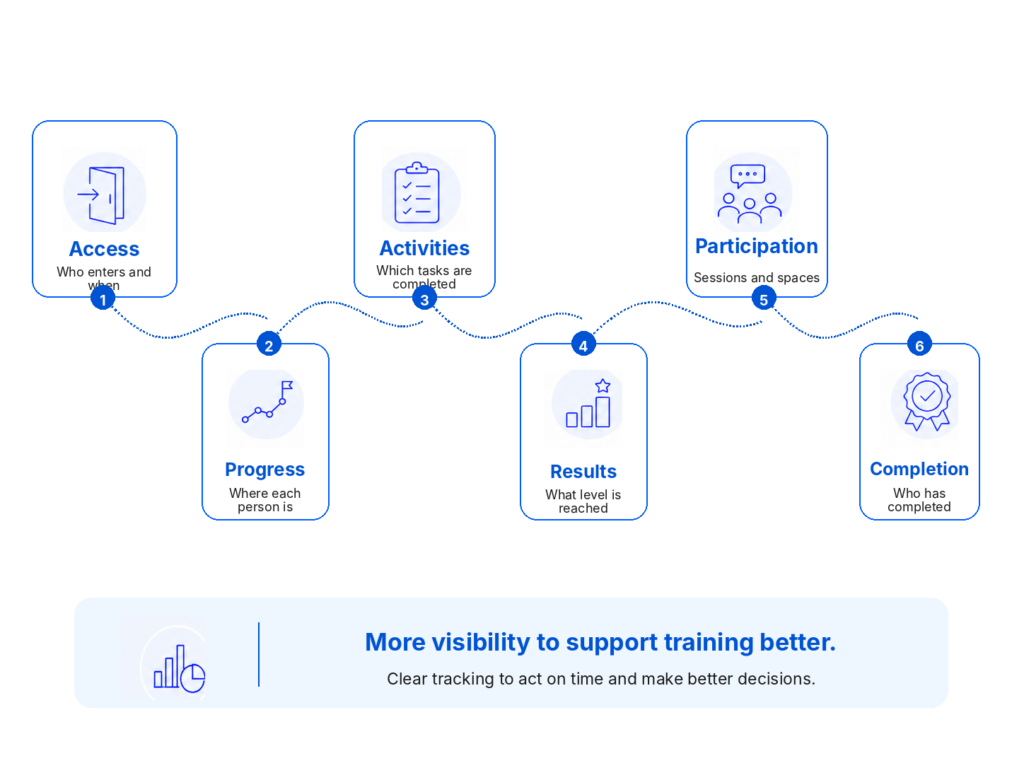
One of the first aspects to track is access. Knowing who has entered the learning environment and who has not makes it easier to detect start-up issues, communication gaps or access difficulties.
Progress is also important. In training organized by modules, units or activities, it is useful to know where each person is and which parts are still pending.
Another relevant aspect is activity completion. Quizzes, exercises, assignments, surveys or practical tasks provide information about participation levels and understanding of the content.
Results should also be tracked. It is not just about knowing whether someone has completed a training action, but also whether they have achieved the defined criteria.
It may also be useful to record participation in live sessions, tutoring, chats, forums, blogs or other interaction spaces, especially when training combines different formats.
Finally, it is important to keep evidence of completion. The company should be able to know who has completed the training, when they completed it and under which criteria.
Useful indicators for internal training tracking
Internal training tracking indicators should be simple, understandable and focused on decision-making.
Some basic indicators may include:
- percentage of people who have started the training;
- percentage of people who have completed it;
- pending activities;
- results obtained in quizzes or assessments;
- connection time or estimated dedication;
- participation in sessions or communication spaces;
- people with low activity;
- people who do not meet the completion criteria;
- participants’ evaluation of the training.
These indicators provide a clearer view of what is happening. But their value does not lie in collecting data. Their value lies in using that data to act.
If many people do not start the training, the problem may be in the initial communication or in the course assignment. If many people drop out at a specific point, there may be unclear content or an activity that is too complex. If results are low, it may be useful to review the explanation, resources or assessment.
Tracking should help improve training, not just record activity.
Individual tracking and group tracking
In internal training, it is useful to combine two levels of tracking: individual and group tracking.
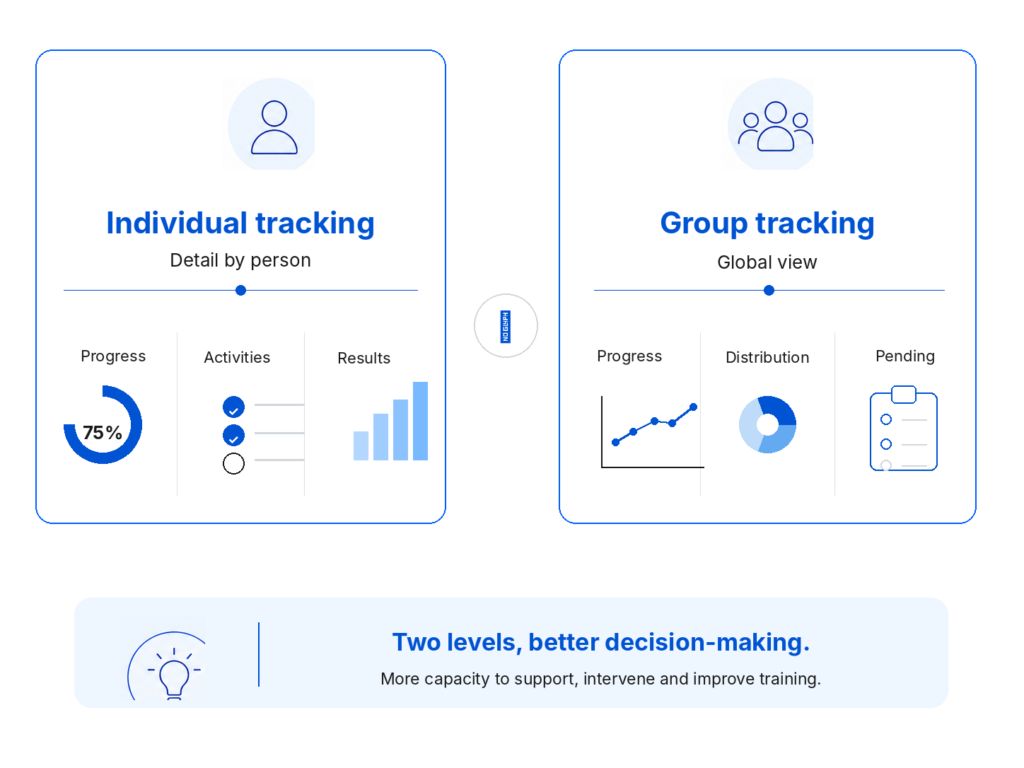
Individual tracking makes it possible to understand each person’s situation. It helps identify who has accessed the training, which modules they have completed, which activities are pending, what results they have obtained and whether they meet the defined criteria. This level of detail is especially important in onboarding processes, mandatory training, role-based learning paths or programs that require completion evidence.
Group tracking, on the other hand, provides an overall view. It helps answer questions such as: what percentage of the team has completed the training, which content is causing more difficulty, which activities have lower results or which group needs more support.
Both levels are necessary. Individual tracking allows personalized intervention. Group tracking supports decisions about the design, planning and improvement of the training program.
How to detect signs of low activity
One of the advantages of tracking is being able to act before someone drops out or falls behind.
Some signs of low activity may include:
- not accessing the learning environment after enrolment;
- starting the course but not progressing;
- having pending activities for several days;
- not participating in communication spaces;
- not attending scheduled sessions;
- obtaining low assessment results;
- missing defined deadlines.
Detecting these signs makes it possible to send reminders, offer support, answer questions, review workload or adapt communication. In many cases, early intervention can prevent training from remaining incomplete.
Completion criteria: when to consider training completed
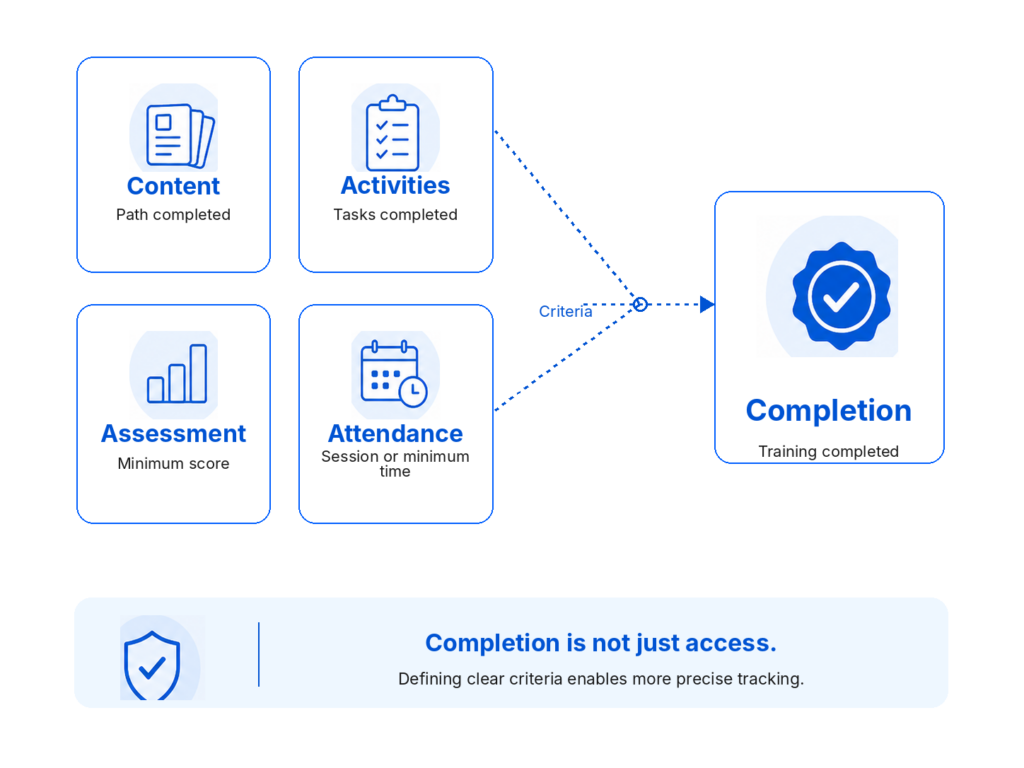
One common mistake in internal training is not clearly defining when a training action should be considered completed. In some cases, accessing certain content may be enough. In others, people may need to complete all activities, pass a quiz, submit a task, attend a session or achieve a minimum score.
There may also be training actions that combine several criteria: minimum progress, mandatory activities, attendance, passed assessment or final survey completion.
Defining these criteria from the start is essential for tracking to make sense. If the company does not know what it wants to verify, it is difficult to interpret the data. Completion criteria also help communicate expectations more clearly to participants. People know what they need to do, what is expected from them and when they can consider the training completed.
Evidence and traceability of completed training
Tracking also has a documentary function. In many companies, especially when working with mandatory training, regulations, internal procedures, quality, prevention or subsidized training, it is necessary to keep evidence.
This evidence may include access records, progress through the learning path, completed activities, assessment results, attendance at sessions, communications sent, certificates or satisfaction surveys.
Traceability makes it possible to reconstruct what training was completed, who took part, when it was completed and with what result. This is not only useful in the event of audits, inspections or justification processes. It also helps the company keep a more organized training record and reduce dependence on scattered documents or specific people.
How to use data to improve training
Tracking should not be seen only as a control tool. Its main value lies in continuous improvement.
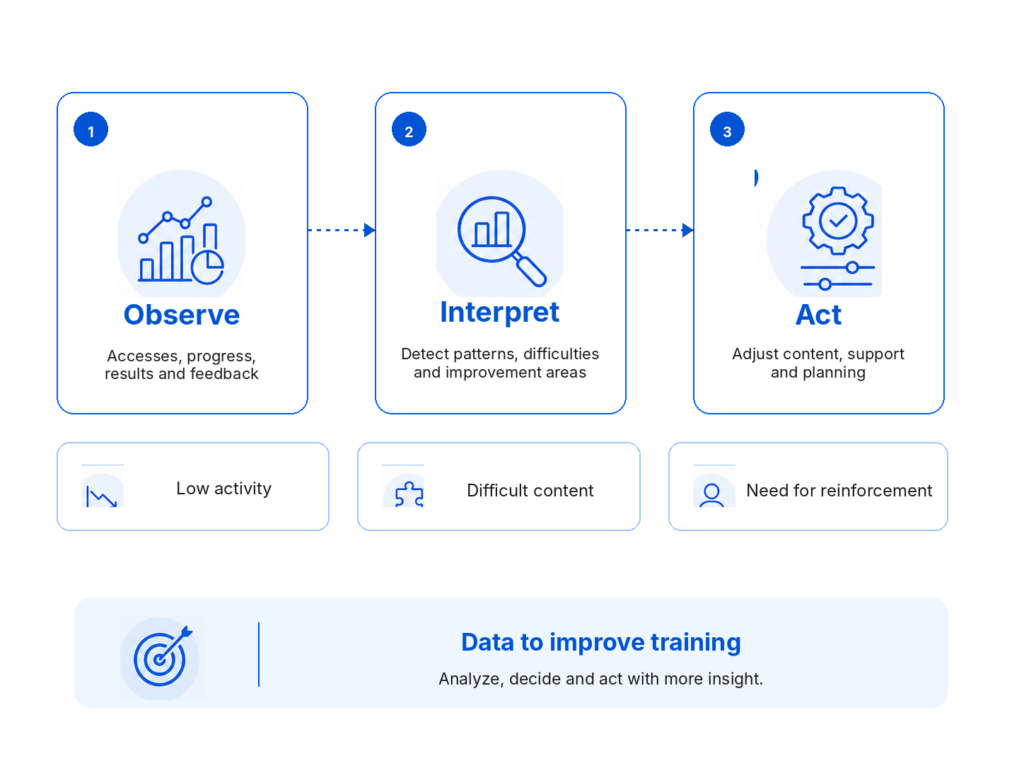
Data can help detect unclear content, activities that generate difficulty, training actions that are too long, poorly sequenced learning paths or groups that need more support. It can also show which training actions work better, which ones have higher participation, which profiles complete them more easily or which resources are more useful.
This information supports decisions: updating materials, simplifying activities, improving instructions, reinforcing specific content, changing the planning or adjusting assessment criteria.
Well-managed internal training does not remain static. It evolves with the company, its teams and its needs.
What an e-learning platform should make easier
When internal training starts to grow, an e-learning platform can make tracking much easier. A good platform should allow the company to check each participant’s progress, view group activity, detect pending tasks, review results, configure completion criteria, send communications to specific people and generate reports.
It should also make it possible to keep evidence in an organized way, preventing information from being spread across emails, spreadsheets, external forms or shared folders. The goal is not to have more data, but clearer, more accessible and more useful data.
An e-learning platform adds value when it helps answer questions such as:
- who has started the training;
- who is progressing;
- who needs support;
- who has completed the learning path;
- what results have been achieved;
- what evidence is available;
- which aspects should be improved.
From controlling training to supporting people better
Tracking internal training does not mean monitoring people in a negative sense. It means having information to support learning better, intervene at the right time and make more informed decisions.
When the company has visibility into progress and results, it can act faster, reduce manual tasks, improve the participant experience and show more clearly the value of the training delivered.
With Weeras Academy, companies can carry out individual and group tracking, review progress through learning paths, check participation and results, configure completion criteria, manage assessed activities, send communications to participants with pending tasks and keep evidence of completed training in a single environment.
If your company already provides internal training but still depends on emails, spreadsheets or manual checks to understand what is happening, it may be a good time to review how to track it in a clearer, more agile and more useful way.