
How to manage several editions of the same course without duplicating work

In this article
- The problem of managing course editions by duplicating deliveries
- Base course and edition: two levels that should be kept separate
- Which elements should remain common
- Which elements should be adapted in each edition
- Scheduled editions and open editions
- How to manage course editions in an organised way
- The importance of notifications and communication by edition
- Tracking by edition: knowing what happens in each group
- Subsidised training: editions with specific requirements
- What an e-learning platform should support
- Benefits of managing editions well
- From copying courses to managing deliveries with criteria
Managing course editions may seem simple when there are only one or two course deliveries per year. But many training centres deliver the same course more than once: a training action repeated every quarter, a course aimed at different companies, a programme offered in several locations or training adapted to different groups of learners.
On paper, the course is the same. It has shared objectives, content, methodology and structure. However, each edition may have different dates, instructors, schedules, groups, completion criteria, specific communications or associated documentation.
When course editions are not managed properly, each new delivery becomes a manual repetition of the previous one. Content is duplicated, settings are copied, dates are checked again, documents are updated, groups are created from scratch and the risk of errors increases.
Managing several editions of the same course should not mean rebuilding everything each time. The key is to clearly separate what belongs to the base course from what needs to be adapted in each edition.
The problem of managing course editions by duplicating deliveries
Some centres manage each new delivery by creating a full copy of the previous course. At first, this may seem like a quick solution: duplicate the course, change the dates and enrol the new group. But over time, this approach can create several problems:
- Loss of version control. If content is changed in one edition but not in another, several versions of the same course can quickly appear, with small differences that are difficult to track.
- Administrative workload. Each new edition requires a manual review of materials, dates, activities, communications, instructors, assessments and documents.
- Risk of errors. An old date, an incorrect notification, an outdated document, an activity with the wrong settings or a completion criterion carried over from a previous edition may remain unnoticed.
- Difficulty comparing results. If each edition has been created independently, it can be harder to analyse how the same course has performed across different groups, periods or formats.
- Dependence on specific people. If only one person knows what has been copied, what has been adapted and what needs to be reviewed, the process becomes fragile.
That is why, when a centre delivers courses on a recurring basis, it needs more than duplicated content: it needs a clear course-and-edition logic.
Base course and edition: two levels that should be kept separate
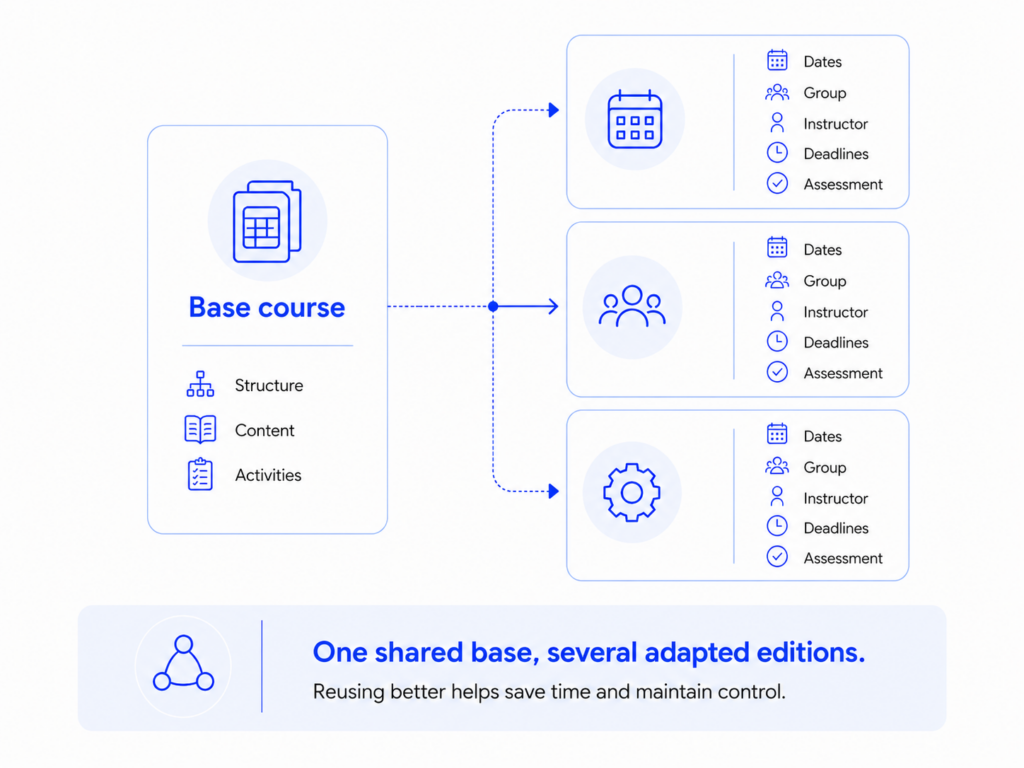
A useful way to manage recurring training is to distinguish between the base course and its editions. The base course contains the common elements of the training action. For example, the general structure, objectives, main content, standard activities, learning resources, methodology, assessment strategy or reusable documents.
The edition, on the other hand, defines how that course will be delivered in a specific instance. It may include dates, calendar, schedule, learner group, teaching team, specific criteria, communications, deadlines, synchronous sessions, complementary resources or adapted documentation.
This separation helps the centre work in a more organised way. It can maintain a shared base while adapting each edition to its audience and circumstances. This avoids creating entirely new courses when, in reality, the centre is delivering a variation of the same training proposal. This distinction is especially useful for managing course editions without losing consistency between deliveries or multiplying administrative tasks.
Which elements should remain common
Not every element needs to be configured from scratch in each edition. Some elements are part of the course identity and should remain stable.
These may include learning objectives, the general description, the module or unit structure, the main content, essential resources, key activities, general assessment criteria or the competencies being developed.
Document templates, message templates, base quizzes, satisfaction surveys, instructor guidelines or learner support materials can also be maintained.
Keeping these elements common helps ensure consistency across editions. The centre can guarantee that everyone taking the same training action receives an equivalent experience, even if dates, groups or instructors change.
It also makes updates easier. If the course design is reviewed, the centre can better identify which elements are structural and which only affect a specific edition.
Which elements should be adapted in each edition
Each edition has its own characteristics. That is why good management should make it possible to adjust variable elements without unnecessarily altering the base course.
The elements that usually change include start and end dates, activity calendar, deadlines, face-to-face or virtual sessions, schedule, teaching team, learner group, notifications, visibility criteria or access conditions.
Associated documentation may also change. For example, certificates, templates, reports, initial communications, specific instructions for the group or documents required for subsidised training.
In some cases, activities or resources may also need to be adjusted. A course delivered for a specific company may require its own examples, adapted cases, additional materials or a slightly different sequence.
The key is to make these adaptations without breaking the general course structure or creating versions that are difficult to control.
Scheduled editions and open editions
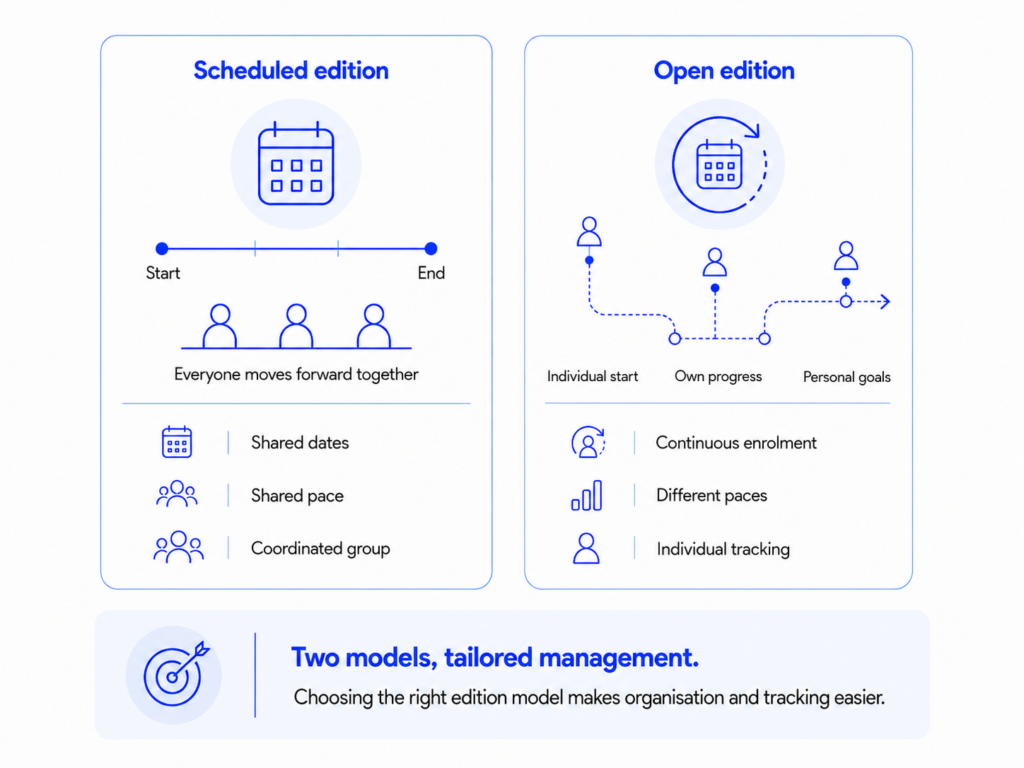
Not all editions work in the same way. Some courses are delivered as scheduled editions. They have a start date, an end date and a group that moves forward more or less together. In these cases, management focuses on planning sessions, opening content at specific times, setting shared deadlines and supporting the group over a defined period.
Other courses work as open editions. Learners can join at different times and progress at different paces. This model offers a high degree of flexibility, but it requires a different type of management: more individualised tracking, adapted communications, automatic reminders and clear criteria to understand where each participant is in the process.
A centre may need to work with both models. For example, it may offer intensive courses with fixed dates while also maintaining self-paced programmes open throughout the year.
That is why the platform used should allow the centre to manage both scheduled editions and open editions, without forcing the same model across the entire training offer.
How to manage course editions in an organised way
To create a new edition in an organised way, it is useful to follow a clear process:
- Review the base course. Before opening a new delivery, it is advisable to check whether the content, activities, documents and general criteria are still up to date.
- Define the edition-specific data. Audience, dates, format, calendar, teaching team, expected number of participants, access requirements and specific conditions.
- Adjust the schedule. This includes sessions, content release dates, deadlines, assessable activities, surveys, tutorials or associated events.
- Review communications. Each edition may need welcome messages, reminders, initial instructions, pending-task alerts or closing communications.
- Validate completion criteria. Even if the course is the same, some editions may have specific requirements, especially in the case of subsidised training, training for a particular company or certification programmes.
- Identify the required evidence. Anticipate the documentation and reports that will be needed during and at the end of the edition.
This process helps open new course deliveries with more confidence and less improvisation.
The importance of notifications and communication by edition
When a course has several editions, communication must be properly segmented. Not all messages are useful for all groups.
One edition may have a different calendar, a different instructor, an additional session, specific instructions or its own deadlines. If communication is not linked to each edition, it is easy to send incorrect messages or create confusion among learners.
That is why each edition should have its own scheduled notifications and communications. The centre can prepare welcome messages, start reminders, pending-activity alerts, instructions for synchronous sessions, assessment communications or closing messages.
This reduces manual work and improves the learner experience, as participants receive the right information at the right time.
Tracking by edition: knowing what happens in each group
Good edition management does not end when the delivery is created. It also requires tracking.
The centre needs to know how each group is progressing, which participants have pending tasks, what results are being obtained, which activities are causing difficulties or which instructors may need support.
Tracking by edition makes it possible to analyse each delivery independently. This is important because two editions of the same course may perform differently. One group may progress smoothly while another may need more support. One edition may achieve good results while another may show difficulties in a specific module.
It also makes it possible to compare editions with one another. This comparison can help improve content, adjust calendars, review instructions or identify good teaching practices. When information is organised by edition, the centre can make more precise decisions.
Subsidised training: editions with specific requirements
In the case of subsidised training, edition management becomes even more important.
The same training action may involve different groups, participating companies, dates, formats, instructors, learning checks, quality surveys or documentation requirements. It is also necessary to keep evidence of activity, participation, attendance, results or completion. Specific information may also need to be made available in the event of an inspection.
That is why editions linked to subsidised training should be configurable and documented in an organised way. It is not only about delivering the course, but also about being able to show how each edition was delivered, who participated, what tracking was carried out and what documentation has been kept.
The more integrated this management is within the platform itself, the less the centre will depend on spreadsheets, external folders or manual checks.
What an e-learning platform should support
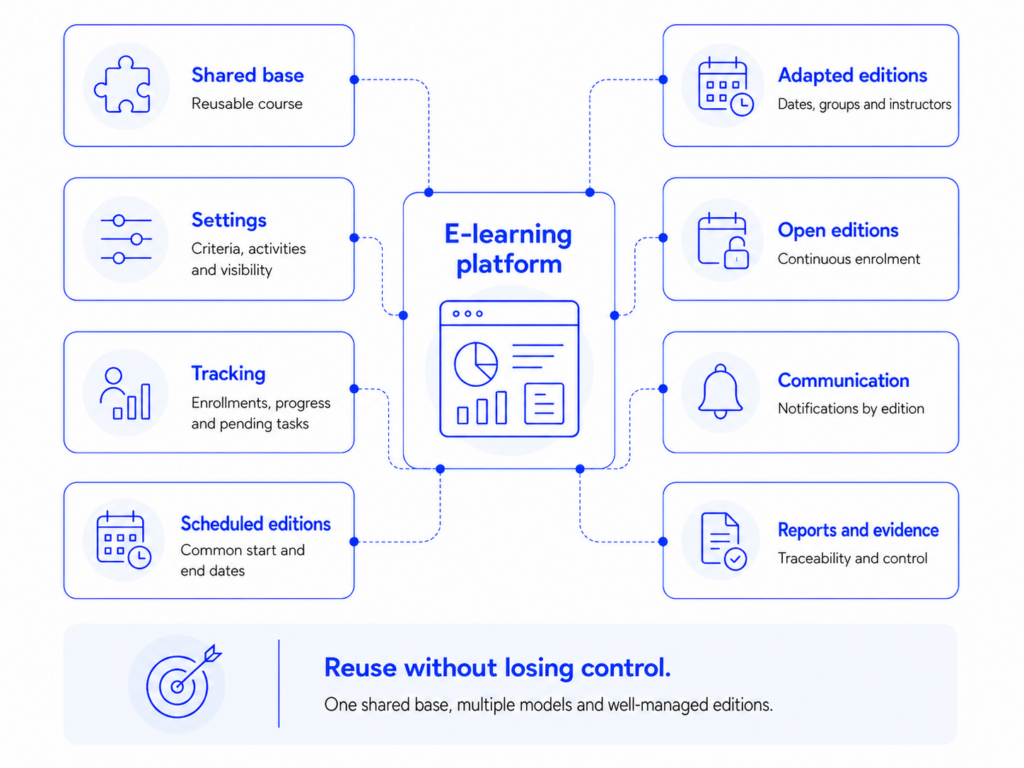
To manage course editions sustainably, the platform should allow the centre to work with a shared structure and adapt it easily to different groups, dates, formats or learner profiles.
An e-learning platform designed for training centres should simplify the management of multiple editions of the same course, allowing teams to work from a shared structure and adapt it easily to different groups, dates, formats or learner profiles.
To do this, it should make it possible to configure independently aspects such as the teaching team, calendar, completion criteria, communications, document templates, content visibility, activities or tracking for each delivery.
It should also provide a clear, centralised view of each edition, including information about enrolled learners, their progress, pending activities, results obtained, communications sent, reports generated and associated documentation.
The aim is to reuse resources without losing control. Reuse does not mean duplicating courses indiscriminately. It means starting from a shared base, adapting it to the needs of each edition and maintaining traceability of everything that has been delivered.
If you are reviewing the range of functionalities a platform should cover, this guide on what an e-learning platform for a training centre should include may also be useful.
Benefits of managing editions well
Managing several editions of the same course properly brings very specific benefits.
The centre saves time because it does not need to rebuild the course every time. It reduces errors because it works with a more controlled structure. It maintains consistency across deliveries because it starts from a shared base. It improves the learner experience because each edition receives adapted information and planning. It also supports instructors because the conditions of each group are clearer.
It also improves the centre’s ability to analyse results. By comparing editions, the centre can identify what works better, where difficulties appear and what changes should be introduced in future deliveries.
In short, good edition management makes it possible to scale the training offer without multiplying the administrative workload.
From copying courses to managing deliveries with criteria
When a centre grows, it cannot depend on manually duplicating courses every time it opens a new delivery. It needs a way of working that allows it to reuse content, adapt what is needed, maintain consistency and track each group.
Managing several editions of the same course is not only a technical issue. It is a way to organise training activity, reduce repetitive work and improve the quality of the training delivered.
In Weeras Academy, centres can create courses and manage course editions from a single environment, adjusting scheduling, teaching team, completion criteria, notifications, document templates, enrolled learners and tracking for each group.
If your centre delivers the same course several times a year or adapts the same training action to different groups, companies or formats, it may be a good time to review how you are managing your editions and how much work you could save with a more structured model.
One comment
Comments are closed.



[…] The platform also lets you create dedicated runs for a single training action or mixed runs in which learners from different training actions and groups study together, making administration and engagement simpler. To find out more about working with course runs, see our article on how to manage multiple runs of the same course. […]