
How to organise internal training without relying on scattered tools

Organise internal training is not always a priority when a company is still small or when training actions are occasional. Internal training often starts in a simple way: a face-to-face session to explain a new procedure, a shared document with instructions, a presentation sent by email, a recorded video for new hires, a spreadsheet to track attendance, a form to collect feedback… At first, this system may work. When the company still has only a few teams involved, training is managed on an occasional basis and the people responsible know what has been done, who has taken part and what remains pending.
The problem appears when training starts to grow: new hires, changes in internal processes, product training, protocol updates, mandatory training, teams in different locations, external collaborators, middle managers who need to train their teams… Gradually, what once seemed manageable begins to fragment. Content is stored in one place. Communications happen somewhere else. Tracking depends on a spreadsheet. Evidence is saved in different folders. And when someone asks who has completed a training programme or what content a team has received, the answer is no longer immediate.
Organising internal training is not just about delivering courses. It is about creating a system that makes it possible to plan, communicate, support, track and retain useful information for improvement.
When internal training grows informally
Many companies do not detect the problem at first because internal training is handled using tools they already use in their day-to-day work: email, video calls, shared documents, spreadsheets, presentations, cloud folders or team chats. These tools are useful, but they are not always designed to manage complete training processes. They are useful for sharing information, but not necessarily for knowing whether a person has actually completed training. They make it possible to send materials, but do not always help structure them into a learning pathway. They support communication, but can create dispersion if each course, session or department uses a different channel.
As a result, the company may be doing a lot of training but have very little visibility over it. And this lack of visibility makes it difficult to answer very basic questions:
- What training has each person received?
- Which content is up to date and which is not?
- Who has pending activities?
- Which teams have completed mandatory training?
- What results have been achieved?
- Which training actions are repeated every year?
- What evidence is kept of the training carried out?
When answering these questions requires checking emails, searching folders, reviewing spreadsheets or asking several people for information, training management starts to depend too heavily on manual effort.
Signs that internal training needs to be organised
Not every company needs a training platform from the very beginning. But there are signs that show the current management approach is starting to fall short:
- Dispersion of materials. Training content is spread across folders, links, documents, presentations, videos, session recordings and old emails. This makes it harder for people to find the right version and increases the risk of using outdated materials.
- Lack of tracking and visibility. The company knows that training has been delivered, but cannot always easily check who has completed it, who has not accessed it, who has passed an assessment or who needs additional support.
- Variability and overload for trainers. Each new hire receives similar explanations, but not always in the same way or with the same resources. This can create differences in the onboarding experience and increase the workload of the people providing training.
- Limited coordination between areas. Human Resources, department managers, internal trainers, administration, management or technical teams may all take part in training, but without a shared space it is harder to maintain a common view.
- Need for evidence. In many training contexts, especially when training is mandatory, assessed or eligible for funding, it is not enough to say that training has taken place. It is necessary to retain information about participation, activity, results or completion.
When several of these signs appear at the same time, internal training is no longer an occasional activity and starts to require a more structured management approach.
What are the risks of continuing to work with separate tools?

Managing internal training with scattered tools is not necessarily a mistake. In fact, many companies start this way because it is a quick and familiar solution. The problem is that, as training activity increases, this model generates hidden costs.
The first is time. Every session announcement, reminder, follow-up or report requires collecting information from different places. What used to be solved quickly begins to consume many hours of coordination.
The second is inconsistency. If each department organises training in its own way, there may be differences in the quality of materials, completion criteria, tracking or communication with participants.
The third is loss of information. When knowledge is distributed across people, folders and documents, context is more easily lost. If the person responsible for a training programme changes, it may be difficult to reconstruct what was done, how it was done and what results were achieved.
The fourth is the difficulty of improving. Without clear data on participation, progress, results or satisfaction, the company has less capacity to detect which training actions work, which need adjustments and where unmet needs appear.
And the fifth is the lack of scalability. A highly manual system can be maintained while there are only a few training actions, but it becomes fragile when the company grows, adds new teams or needs to train people on a recurring basis.
What should a company centralise?
Organising internal training does not mean digitising everything at once or turning every piece of content into a complex course. It means identifying which elements should be centralised so that management becomes clearer and more sustainable.
The main elements to organise are:
Training pathways. Not everyone needs the same training or at the same time. Defining specific pathways for new hires, team leaders, technical profiles, sales staff or external collaborators helps provide a more coherent experience adapted to each need.
Training objectives and criteria. Before organising content or activities, it is useful to define what people are expected to learn, what knowledge or skills they should acquire and how the company will check whether the training has fulfilled its purpose. Clear criteria help design more coherent training actions aligned with the company’s needs.
Content. Manuals, videos, presentations, documents, links, interactive resources or recordings should be organised so that people can access the information they need without relying on old emails or poorly structured folders.
Activities. Internal training does not have to be limited to sharing content. It may include quizzes, exercises, assignments, surveys, practical activities or participation spaces that help check understanding and encourage application in the workplace.
Communications. Invitations, reminders, instructions, pending task alerts or closing messages should be part of the training process itself, rather than relying only on isolated emails.
Tracking. The company needs to know who has accessed the training, who is progressing, who completes it, who meets the defined criteria and which people require additional support.
Evidence. In certain contexts, it is important to retain records of participation, completion, results, attendance or training feedback.
Continuous improvement. An organised approach makes it possible to review which training actions are repeated, which achieve better results, where difficulties arise and which content needs updating.
How to organise internal training step by step
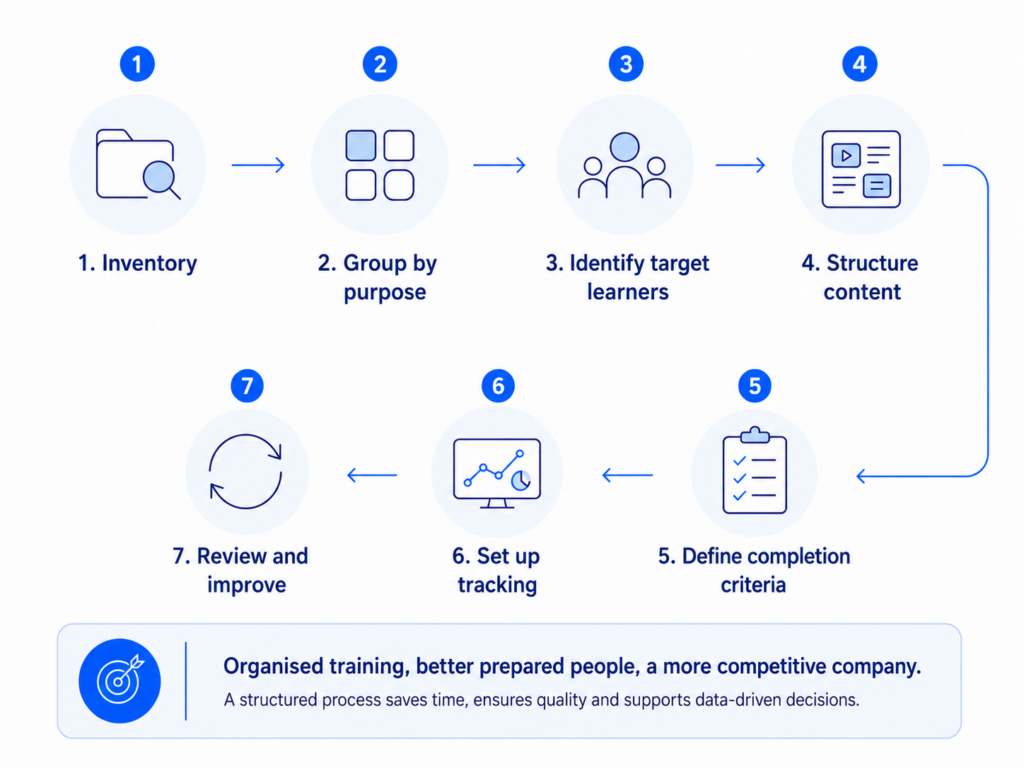
It is not necessary to transform all company training at once. The most effective approach is usually to move forward gradually, identifying what content already exists, how it is being managed and which aspects are causing the most difficulties.
These steps can serve as a guide to start structuring internal training in a more organised and sustainable way:
- Take inventory of the training that already exists in the company.
This is not just about listing formal courses, but also internal sessions, onboarding materials, protocols, recurring training, product explanations, workshops, manuals or content that is regularly shared with employees or collaborators. - Group training actions by purpose.
For example: onboarding, technical training, product training, internal processes, occupational risk prevention, regulatory compliance, cross-functional skills, sales training or training aimed at clients and partners. - Identify the target learners.
The same company may need different pathways depending on professional profile, department, location, level of responsibility or the moment each person is at within the organisation. - Turn scattered content into clearer training structures.
It will not always be necessary to create long courses. Sometimes, short modules, learning pills, simple pathways or resources arranged in a logical sequence will be enough. - Define completion criteria.
Is accessing the content enough? Is it necessary to complete an activity? Does a quiz need to be passed? Is attendance at a synchronous session required? Is a final evaluation needed? Without these criteria, it is difficult to know when a training action can be considered completed. - Establish a tracking system.
The company should be able to consult participants’ progress without having to reconstruct the information manually. - Review results periodically and make the necessary adjustments.
Internal training should evolve with the company. New processes, new tools, regulatory changes, new team needs or participant feedback may require adjustments to the content and the way training is delivered.
When does it make sense to use an e-learning platform?
If a company runs an isolated session for a small group, it may be able to manage it with simple tools. A platform starts to add value when training is repeated, when many people participate, when several profiles are involved, when tracking is needed or when the company wants to retain evidence of what has been done.
It also makes sense when training combines different formats: online content, face-to-face sessions, video conferences, activities, quizzes, tutoring, communications and surveys. In these cases, having a shared environment helps make the experience more coherent.
Another common scenario is onboarding. Each new hire needs access to key information about the company, its processes, tools, products and way of working. When this process is structured, the experience is clearer for the person joining and more efficient for the organisation.
It is also useful when the company wants to design pathways by profile. Training a new employee, a middle manager, a sales team, a support technician or an external collaborator is not the same. A platform makes it possible to organise different routes and track each one.
Finally, a platform can be especially relevant when the company needs to justify or document the training carried out. In these cases, traceability stops being an additional element and becomes an essential part of management.

From delivering training to managing knowledge
The challenge of internal training is not just to offer courses. It is to build a system that helps the company share knowledge, update it, measure it and deliver it to the right people at the right time. When training is well organised, it stops depending on isolated efforts. Content is reused more effectively, new hires receive a more consistent experience, managers have more visibility and the company can make decisions with more information.
Organising internal training does not mean making it more complicated. On the contrary: it means reducing dispersion, facilitating access, improving tracking and freeing up time to focus on what matters most: helping people learn, apply what they have learned and contribute to the organisation’s growth. With Weeras Academy, companies can structure their internal training programmes through courses, editions and training pathways, incorporating resources, activities, communications, tracking and management tools in a single environment.
If your company is starting to notice that internal training depends too much on emails, folders, spreadsheets or manual processes, it may be a good time to review how to organise it in a clearer, more scalable and more sustainable way.