
How to design training pathways for different profiles within a company
Training pathways for companies help bring order to an increasingly common situation: not everyone needs to learn the same thing, with the same level of depth, or at the same time. In many organizations, internal training starts by being organized around topics: training on internal processes, a session on a new tool, a product course, a regulatory update or an onboarding activity for new hires.
At first, this approach can work. Teams are small, needs are similar and the people responsible for training know what each profile needs to learn. But the problem appears when the company grows or when training becomes more recurrent. A new hire does not have the same needs as someone changing roles. A sales team does not need the same pathway as a technical team. A middle manager requires different training from someone who only needs to update a specific procedure.
When training is not adapted to different profiles, two problems can appear at the same time: some people receive content they do not need, while others do not access information that would be important for their work. Designing training pathways makes it possible to structure clearer, more relevant and easier-to-follow learning routes.
In addition, if the company has already started to organize its internal training, this step helps move from general training management to learning that is better aligned with each role. In this sense, it can complement previous work on organizing internal training and tracking internal training.
Why not everyone needs the same training
Many different profiles coexist within a company. Some people have just joined and need to understand the culture, processes, tools and ways of working of the organization. Others already know the company, but need to update their knowledge, take on new responsibilities or adapt to a change in procedures.
There are also differences between departments. The sales team may need training on product knowledge, sales arguments, objections, sales processes or CRM tools. The support team may require more technical knowledge, customer service protocols, incident management or escalation criteria. Middle managers may need training in leadership, communication, team monitoring or performance management.
In addition, not all profiles have the same relationship with the company. Some organizations also train external collaborators, distributors, partners, clients or suppliers. In these cases, training needs to be even clearer and more structured, because the company cannot always rely on informal explanations or face-to-face support.
That is why organizing internal training only by content may not be enough. It is also necessary to think about who needs to learn what, when they need it and for what purpose.
Signs that the company needs training pathways
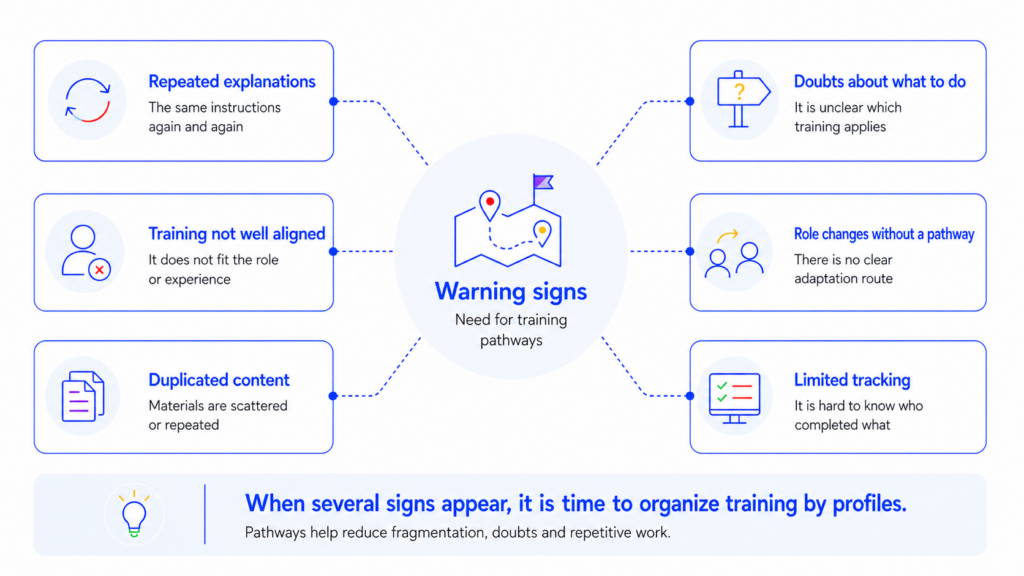
Not every company needs to design complex pathways from the beginning. But there are signs that internal training is starting to require a more structured approach.
One of the first signs appears when each new hire receives similar explanations, but not always in the same order or with the same materials. This can create differences in the onboarding experience and increase the workload of the people supporting new profiles.
It may also happen that the people responsible for training repeat the same instructions again and again. When questions keep coming up, it does not always mean that the team has not understood. Often, it indicates that there is no clear, accessible and shared pathway to explain processes, tools or working criteria.
Another common sign is that some teams receive training that does not fit their role or level of experience. This can lead to lack of interest, wasted time or the feeling that internal training does not bring real value to day-to-day work.
The company may also detect duplicated content in folders, presentations, courses or different documents. If there is no clear structure by profile, it is easy for each area to create its own materials and, over time, for different versions of the same explanation to appear.
In addition, when it is not clear what training each profile should complete, it becomes harder to know which content is mandatory, which is complementary and what route each person should follow. This situation usually becomes more visible during role changes, internal promotions, the incorporation of new teams or company growth.
When several of these situations are repeated, the company does not just need more content. It needs a clearer training architecture. Training pathways for companies help organize that architecture and connect training with specific profiles, roles and needs.
The risks of giving everyone the same training route
Offering the same training to everyone may seem like a simple way to ensure that information reaches the whole organization. However, as the company grows, this approach can create several problems.
The first risk is overload. If a person receives too much information that is not connected to their role, they are more likely to lose interest, struggle to progress or fail to identify which content is truly important for them.
The second risk is lack of depth. In order for the same course to serve very different profiles, the content often ends up remaining too general. This may mean that some people do not receive the specific training they need to perform their role well.
The third risk is the appearance of training gaps. When it is not defined what each profile needs to learn, certain knowledge may be taken for granted, even if there is no clear evidence that it has been acquired.
The fourth risk is the difficulty of tracking progress. If all profiles go through the same route but have different needs, it becomes harder to interpret the data. Low activity may be due to lack of time, lack of relevance, too much content or a real learning difficulty.
And the fifth risk is limited scalability. When training depends on individual explanations and improvised adaptations, every team expansion increases the workload of the people responsible.
What a training pathway means within a company
A training pathway is an organized learning route designed for a specific profile, function or need. It is not simply a group of courses. It is a meaningful route that defines what a person needs to learn, in what order, with which resources, through which activities and under which criteria the training will be considered complete.
A pathway can include different types of content: documents, videos, live sessions, practical activities, quizzes, assignments, tutorials, reference resources, assessments or surveys. It can also combine mandatory and optional training.
The key is that the pathway responds to a clear purpose. For example:
- helping a new hire become autonomous in less time;
- helping someone changing roles understand their new responsibilities;
- helping a sales team master the product narrative;
- helping middle managers share management criteria;
- helping the whole workforce update a mandatory procedure;
- helping an external collaborator understand the company’s working standards.
When the pathway is well designed, the person knows what they need to do and the company can support the process more effectively. In addition, if the organization already has a system for tracking internal training, it can more easily see who is progressing, which activities are pending and which profiles need support.
Types of training pathways a company may need
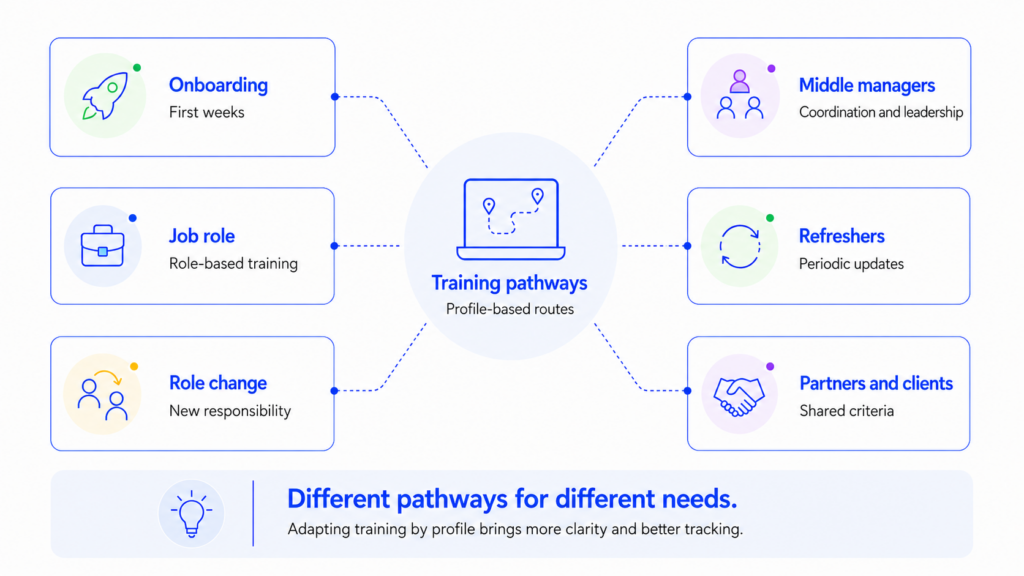
Each company should define its pathways according to its activity, structure and priorities. Even so, there are several common routes that often appear in many organizations.
Onboarding pathway
Onboarding is one of the clearest cases. A new hire needs to understand the company, its culture, tools, processes, communication channels, reference people and the expectations associated with their role.
An onboarding pathway helps avoid having each new hire depend exclusively on the availability of their manager or team. It also makes it possible to offer a more consistent experience and reduce repeated questions during the first few weeks.
Role-based pathways
Not all roles require the same training. A sales, technical, administrative, teaching, operations or customer service profile may need specific routes. Designing pathways by role helps connect training with the real tasks of each position.
These pathways may include a common part for the whole company and a specific part depending on department, function or level of responsibility.
Pathways for role changes
When someone takes on new functions, their previous experience is not always enough. They may need training on new processes, tools, decision criteria, responsibilities or coordination methods.
A pathway for role changes facilitates that transition and prevents learning from depending only on informal observation or occasional explanations.
Pathways for middle managers
Middle managers often play a key role in transmitting criteria, coordinating teams and following up on work. For this reason, they may need specific routes on leadership, communication, people management, feedback, planning or decision-making.
This type of pathway helps align how teams are managed and reduces excessive differences between departments.
Update or refresher pathways
Some training needs to be repeated periodically: regulatory changes, prevention, quality, security, data protection, internal processes or product updates. In these cases, the pathway should make it possible to check who has completed the update, when they completed it and with what result.
Pathways for collaborators, partners or clients
Some companies do not only train their own staff. They also need to train distributors, external collaborators, franchises, clients or suppliers. In these cases, pathways help transmit shared criteria, explain products or services, improve autonomy and reduce repeated queries.
How to design training pathways for companies step by step
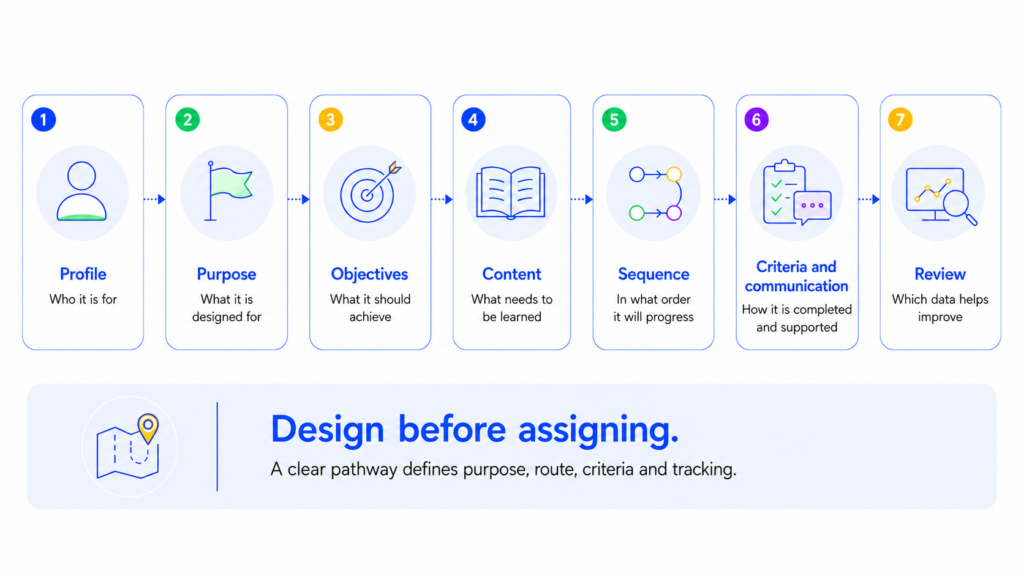
Designing training pathways for companies does not mean creating complex routes from the outset. The most advisable approach is to start with the profiles or needs that generate the most workload, repetition or risk if they are not managed well.
1. Identify priority profiles
The first step is to decide who the pathway is for. It may be a professional profile, a department, a level of responsibility, a stage within the company or an external group.
It is useful to start with simple questions:
- Which profiles need recurrent training?
- Which people require a quick adaptation process?
- Where do the same questions appear most often?
- What knowledge is critical for working autonomously?
- Which processes generate more errors when they are not well explained?
These questions help set priorities.
2. Define the purpose of the pathway
Before selecting content, it is important to clarify what the pathway is for. Designing a route to inform is not the same as designing one to train a skill, meet a requirement, reduce errors or speed up the autonomy of a new hire.
A clear purpose helps decide which content is necessary and which can be left out.
3. Set learning objectives
Each pathway should respond to specific objectives. At the end of the route, the participant should be able to do something, understand something or apply specific criteria.
For example:
- understand basic internal processes;
- use a tool correctly;
- apply a customer service protocol;
- identify the stages of a sales process;
- solve common incidents;
- meet the requirements of mandatory training;
- take on new coordination responsibilities.
The clearer the objectives are, the easier it will be to design the route and assess whether it has fulfilled its purpose.
4. Select content and resources
Once the objectives have been defined, it is useful to select the content that is truly necessary. Many companies already have useful materials: manuals, videos, presentations, recordings, process documents, internal guides or product resources.
The work does not always consist of creating content from scratch. Often, the first step is to organize what already exists, remove duplicates, update materials and decide which resource best fits each part of the pathway.
This work is directly connected to the need to organize internal training (URL-DE-LA-ENTRADA-B01-EN), because it is difficult to build effective pathways if materials are scattered, duplicated or outdated.
5. Organize the sequence
A pathway should not be a simple list of content. Sequence matters. Some knowledge needs to be acquired before other knowledge. There may also be moments when it is useful to combine self-paced content, live sessions, practice, assessable activities or tutoring.
A clear sequence helps the person understand where to start, what to complete next and how to progress without getting lost.
6. Combine formats
Not all learning works in the same way. Some content can be addressed through short documents or videos. Other content requires a practical session, an applied activity, a quiz, an assignment or a space for questions.
Combining formats helps create more useful pathways. The key is not to add many tools, but to choose the ones that best respond to each objective.
7. Define completion criteria
A pathway needs clear criteria to know when it can be considered complete. In some cases, it may be enough to go through the mandatory content. In others, it may be necessary to complete activities, pass quizzes, attend sessions, submit a practical task or reach a minimum score.
Defining these criteria from the start helps communicate expectations better and makes follow-up easier.
8. Plan communications and reminders
Communication is also part of the pathway. Participants need to know what they have to do, by when, which content is a priority, when sessions are scheduled and where they can ask questions.
Welcome messages, reminders, pending task notifications or closing communications can significantly improve the experience and reduce manual follow-up work.
9. Review the pathway using data
A pathway should not remain fixed forever. Once it is running, it is useful to review how it works: who completes it, where difficulties appear, which activities generate more questions, which content is consulted less and what feedback participants provide.
This review makes it possible to adjust the sequence, improve materials, simplify activities or reinforce specific content.
What to measure in each pathway
Tracking a pathway should focus on useful information. It is not about measuring everything, but about having data that helps support people better and make decisions.
Some important elements include:
- who has started the pathway;
- where each person is in the route;
- which content has been completed;
- which activities are pending;
- what results have been obtained;
- which people show low activity;
- which completion criteria have been met;
- which evidence is stored;
- what feedback participants provide.
This information makes it possible to act in time. If a person does not start the pathway, they may need a reminder or access support. If many people stop at the same point, perhaps the content is unclear or the activity needs to be reviewed. If results are low, part of the route may need reinforcement.
Tracking turns the pathway into a living tool, not a closed structure.
How to prevent pathways from becoming rigid routes
A training pathway should bring order, but it should not become a rigid structure that prevents adaptation to real needs. The company can define a common base while allowing variations according to profile, previous experience, calendar, format or level of responsibility.
For example, an onboarding pathway may have a common part for all new hires and specific modules depending on the department. A sales pathway may include mandatory product content and complementary resources depending on the market or type of client. A pathway for middle managers may combine common training with activities adapted to each area.
Flexibility is important because companies change. New processes, new tools, new products, new regulations or new ways of organizing work appear. That is why pathways should be easy to update without every change forcing the company to rebuild the whole system.
What an e-learning platform should make easier
When a company starts working with training pathways for companies, an e-learning platform can help centralize the structure, communication, tracking and evidence.
A good platform should make it possible to create courses and group them into coherent routes for different profiles. It should also make it easier to organize resources and activities, configure completion criteria, plan communications and track both individual and group progress.
In addition, it should help answer key questions:
- Which pathways are assigned to each profile?
- Who has started the route?
- Who is progressing properly?
- Who has pending activities?
- What results are being obtained?
- What evidence is being stored?
- Which content should be reviewed?
- Which pathways work best?
The platform does not replace pedagogical design or the reflection on the company’s needs. But it can reduce dependence on emails, spreadsheets, shared folders or manual checks.
From isolated courses to meaningful learning routes
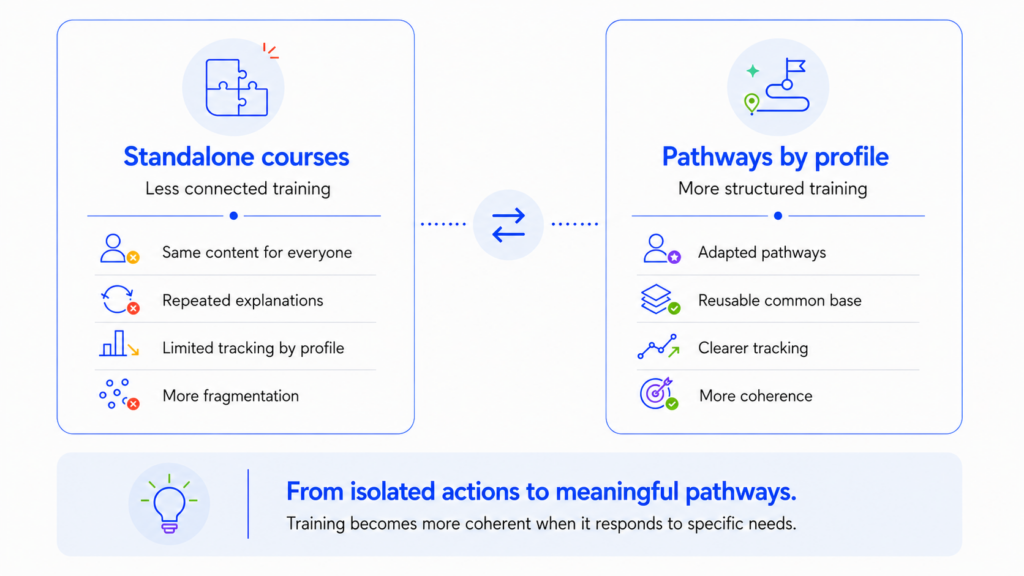
Designing training pathways for companies makes it possible to move from internal training based on isolated actions to a more organized, coherent and scalable model. The company stops asking only what courses are available and starts asking what each profile needs to learn in order to work better.
This helps improve onboarding, support role changes, reduce repeated questions, align criteria between teams and track completed training. It also makes it possible to reuse existing content better and adapt it to different needs without duplicating effort.
In Weeras Academy, companies can structure internal training programs through courses, editions and training pathways, incorporating resources, activities, communications, completion criteria, individual and group tracking and reports in a single environment. This can help organize routes by profile, support each person’s progress more effectively and store evidence of completed training.
If your company is reviewing how to train different profiles without depending on repeated explanations, scattered folders or manual follow-up, it may be a good moment to identify which pathways should be structured and what information you need in order to manage them more clearly.